Marketplacificiation
Marketplacification
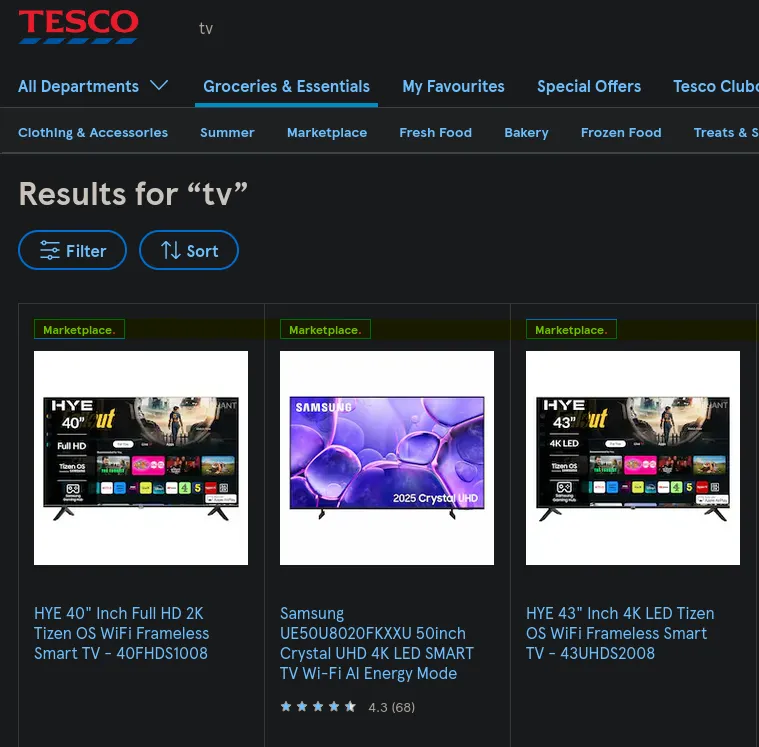
An example of a Tesco search for "TV", showing all the top results are marketplace sellers.
| Stock Price | Up |
| Just Amazon 2? | Yes |
| Customer Support | 0.0001 Mins/Purchase |
| Quality | Optional |
Marketplacification is the process by which a trusted, first-party retailer rents out its own storefront to third-party sellers, allowing those sellers to launder their reputation through a brand customers already trust, in exchange for a cut of every sale.
This is great for customers, because it means that when they visit a well-known retailer for a specific, reliable product, they now also get a second, unrelated store bolted on top, staffed by sellers the retailer has never met and can't vouch for. Some pioneering companies, such as Tesco, B&Q and Argos, have recently discovered this previously unexplored business strategy, first pioneered decades earlier by a small online bookstore.
When something goes wrong, customers benefit from what is known as compounding support: instead of dealing with one company's slow, outdated support system, they now get to deal with two. The retailer directs them to the seller, the seller directs them back to the retailer, and somewhere in that loop, two mediocre support systems combine to form something greater than the sum of their parts.
Marketplacification is also good for the retailer's bottom line, since it lets them collect a fee for every transaction without needing to hold any inventory, guarantee any quality, or take responsibility when a listing turns out to be counterfeit, mis-described, or simply never shipped. Analysts refer to this as "de-risking," since all of the risk has been successfully relocated to the customer.
International adoption
Marketplacification is often assumed to be a spontaneous, independent innovation, arrived at separately by retailers around the world who all happened to have the same idea at once. In fact, it was invented in Seattle in the year 2000 by a single online bookstore, and every other retailer on this list spent the following two decades watching it happen, insisting they would never do such a thing, and then doing it anyway.
- Germany: Otto, once known as a mail-order catalogue and later a standalone department store, now operates a marketplace hosting tens of thousands of third-party sellers, alongside its own first-party range, which customers are welcome to locate if they have the patience.
- France: Cdiscount and Fnac both allow outside sellers to list directly beside first-party stock, a practice widely credited with giving customers the thrilling uncertainty of not knowing who they've actually bought something from until the parcel arrives.
- United States: Target and Best Buy have each launched their own marketplaces in recent years, joining Walmart, which spent over a decade watching its Seattle-based rival before concluding that, yes, that did look like a good idea after all.
- Australia: Myer and Catch both operate marketplace arms, allowing Australian shoppers to enjoy exactly the same third-party seller experience as everyone else, just with longer shipping times.
Industry analysts note that no major retailer has yet reversed this decision, a fact frequently cited as evidence that it is working exactly as intended, rather than evidence that reversing it would require admitting it was a mistake or, worse, admitting who had the idea first.
It is worth noting that the United States did not simply invent marketplacification; it has since gone on to adopt it faster, more thoroughly, and with fewer consumer protections than anywhere else on this list, a pattern some commentators attribute to a broader national talent for identifying a profitable idea and immediately removing whatever regulatory friction might have slowed it down. Where German and French rollouts have been described as "gradual" and "cautious," the American approach is more commonly described using words like "inevitable."
Examples
The screenshots below, taken from the Argos, B&Q and Tesco websites, show marketplacification in its natural habitat[note].
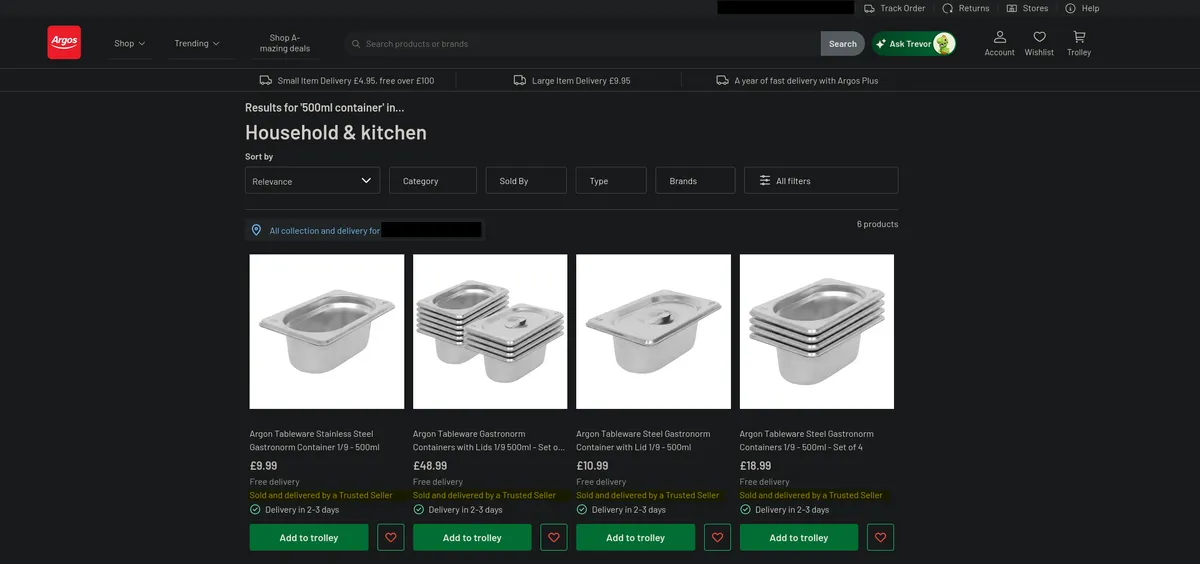
All four top results for "500ml container" on Argos are "Sold and delivered by a Trusted Seller" called Argon Tableware, a name selected entirely at random and bearing no resemblance to any existing retailer.
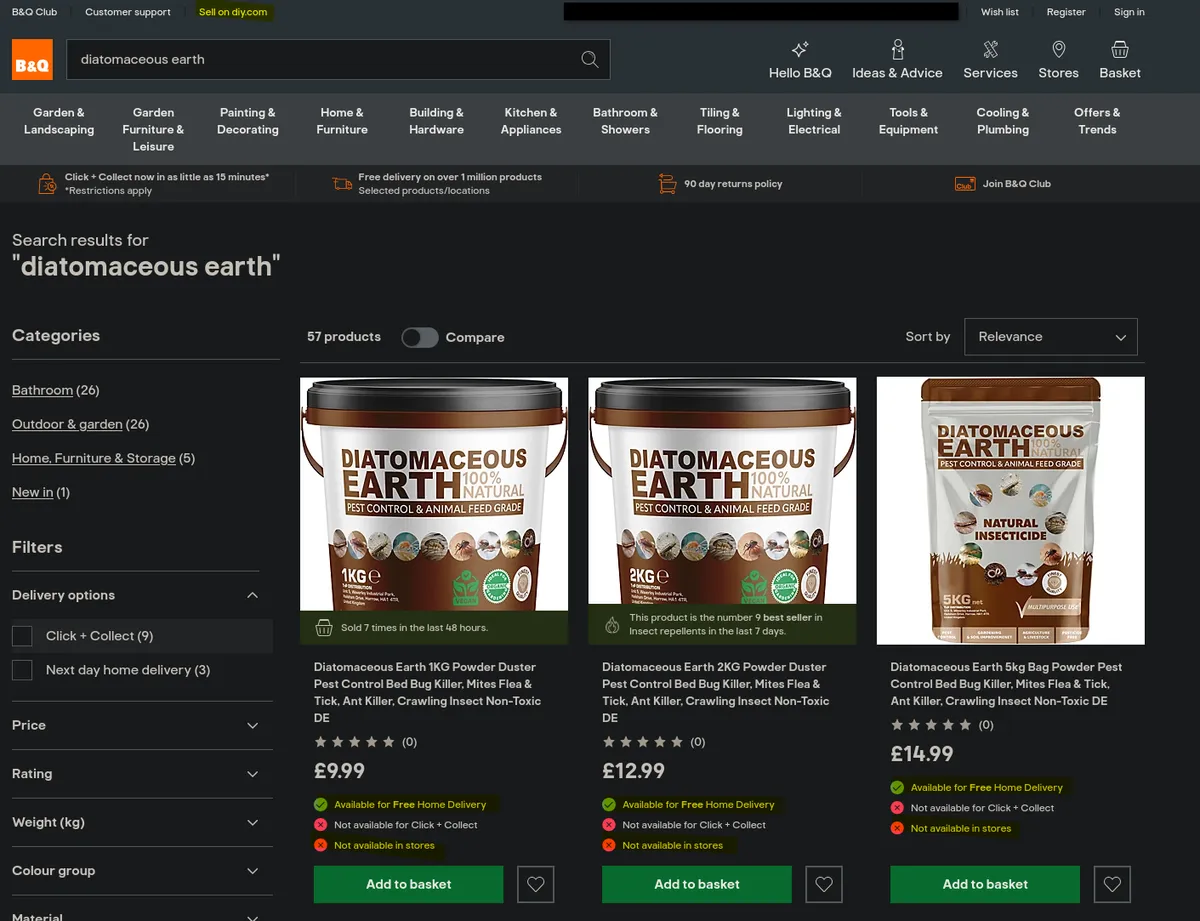
B&Q's header proudly advertises "Sell on diy.com" beside the search bar, ensuring that anyone hunting for diatomaceous earth is also reminded they, too, could be selling diatomaceous earth.
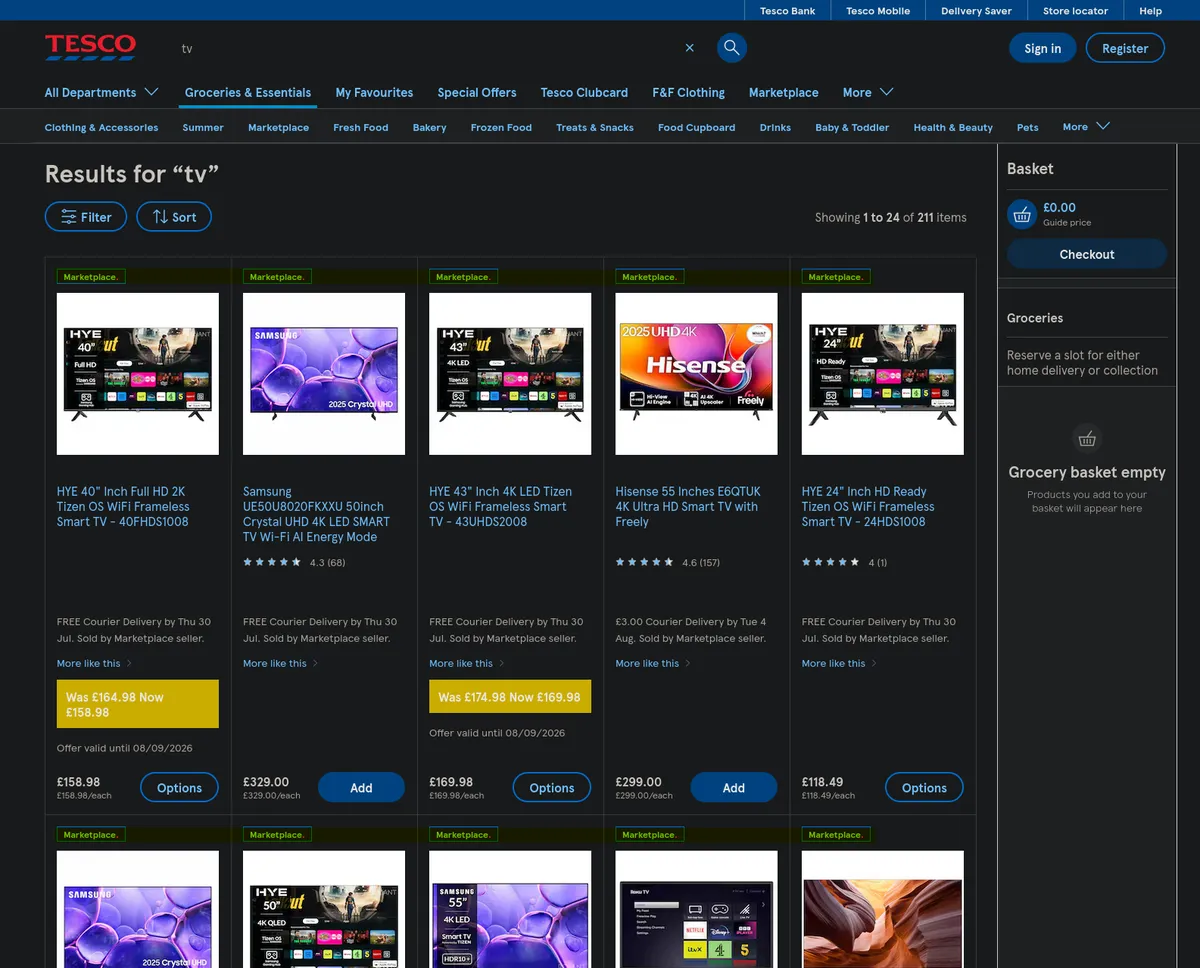
Every single one of Tesco's 211 results for "tv" is tagged "Marketplace," a category that, going by this search, now appears to include the entire television department.